US Army Retired

US Army Retired
Showing posts with label France. Show all posts

Saturday, November 14, 2015

The Paris Terrorist Attacks

Terrorism is just another word for War

Groups and governments have used tactics to terrorize their enemies throughout the history of Mankind. Carpet bombings during WWII were an effort to terrorize Germany and Japan to sue for peace. Gas attacks during WWI was a similar effort. B-52 raids in Vietnam were a similar tactic. And then we have “Shock and Awe” the efforts of Desert Storm.

Paris is Just a Small Slice of WWIII?

Those are Pope Francis' words.

Is he right or wrong?

First, we have a major invasion of Europe by people from the Middle East and Africa. At what point do they actively set about changing the very mores and customs of the various countries? Impost their Sharia Law?

From the beginning, I've tried to keep this blog light and entertaining. Although I am deeply interested in politics, religion, and world affairs, I've kept them off this site.

However, the November 13 attacks in Paris give me no choice but to share information about them with you who follow this.

This will sound cold, but it appeared quite easy to carry them out – especially since the attackers cared nothing for their own lives. They clearly expected to do and appeared willing to accept death.

Some years ago, I wrote Blood in the Meadow about a New Year's Eve terrorist attack in Las Vegas. In doing the research, it frightened me to discover just how easy that would be and what little was needed to do it. It could happen there or anywhere in America – or the world. And sadly, it could easily happen here – or anywhere in the world unless authorities take strong steps to stop it.

Do they have the determination to do what is needed? I doubt it.

My next post is a recap of news items on the Paris terrorist attacks.

Monday, November 7, 2011

Back to the Daily Grind

During the train ride back from Italy, we were loaded down with all sorts of gifts and foods to keep us fed during the long journey. The Italians riding in our train car knew we were American GIs and beamed with pride when someone would translate for us that all our loot came as gifts from Ralph's home village. As if what we carried wasn't enough, no few fellow travelers tried to add to our riches.
We had no thought of the upcoming crossing into France until we stopped at the last train depot before the border and an Italian customs inspector came on board. He asked for our ID cards and then asked where our sacks of stuff came from. He too beamed when he learned of Ralph's trip home but frowned as he told us he felt certain the French customs inspectors would demand a “small gift” from us in order not to confiscate what we carried.
In our stupid smugness, we hadn't even given it a thought. In fact, we'd forgotten all about financial matters as our entire stay in the village had been free. If we tried to offer to defray costs, we were informed our offers were insulting – however nicely it was done. So, we had exactly the number of dollars we'd had on the trip south. Fortunately, the Italian customs guy came to our defense and rode with us across the border into France. He took the French customs inspector aside and whispered with him. It was clear the two were arguing. However, in the end, two twenty dollars bills went from our hands to his and he gave us a paper with a big red seal that indicated duties had been paid on our goods. The Italian simply shook our hands and wished us a safe trip back to Bussac.
One of my favorite experiences in the village had been riding around on near little motor scooters. One easily cut in and out of the byways and alleys. I decided I was going to buy one the first chance I got. So, after spreading around some of the goodies with the guys in the platoon, we stored the remainder of our stuff and prepared to get back to business.
I've never been a frugal individual and whatever savings account I'd had was only there at Duple's insistence. But, the first thing I did when we got back to camp was to go to the Ameican Express Office to open a savings account. I actually kept my promise to myself of depositing 25% of my meager paycheck in the account. I even stopped the trips into Bordeaux to enjoy the GI bars and kept my sightseeing to my moped. It was cheaper. And, the French people of the small villages seemed far less disapproving of an ignorant American who did not share their belief in French superiority. Sitting at a café table slowly sipping a glass of wine and watching people [you can imagine which type of people] was a great – and cheap – way to pass an afternoon.
Like most things that happen when one is young and in the military, the chance to buy a motor scooter seemed to fall into my lap. I went to the Service Club to pass the time playing one of my favorite card games – Pinochle – and saw a note posted on the bulletin board. Someone was heading back to The World and had to sell his motor scooter. I quickly took down the note and got in contact with him the next day. He named a very reasonable price and I hit up one of my buddied for the few bucks I needed over what I had in the Amexco account. With a Bill of Sale I'd typed up at work, I passed over the money and was the proud owner of a Lambretta motor scooter.
It needed work. One of the cables had to be replaced. The brakes were worn. And the paint had a lot of scratches. Again, I managed to forego all little extras and saved up enough to go into the nearest town, Angoulême, to buy the parts. Unlike most of my fellow GIs, I had no thought of paying the first price offered. My moped rides had taught me that nobody in France ever paid the posted price! I bartered at length with the guy, actually walking out of the shop twice, until I got what I thought was a good price. [I later learned, of course, that he still took me for about 25% more than they were worth.]
The lieutenant allowed me to keep it parked at the shop so, on a Saturday, I was able to work on it there. It probably took me a bit longer than someone who actually knew what they were doing, but I fixed it. I also used sandpaper to remove some of the scratches in the paint and even banged out a couple of dings. I then took a can of bright blue spray paint and turned my new transportation into a work of art.
Oh yeah. I had no problem selling for moped for a few dollars more than I'd paid for it. A new 'cruit arrived from Stateside.
I poured through the maps in the Service Club trying to decide where I would go for my first trip. The Pyrenees seemed to be a beautiful place to visit. Doing some calculations, I figured it was a little over 300 kilometers to Bayonne and not much further beyond that to the mountains. At the Lambretta's top speed of 45mph, that was about a 5 hours ride. From there, a lot of side roads would take me along the flanks of the mountains to one place I wanted to see – Lourdes. A stop at Bairritz would also give me a chance to see if bikinis were as popular as I was led to believe.
Now it was just a matter of waiting for the next payday and getting an overnight pass – which isn't that hard when one is the company clerk.
Jusqu'à ce que le prochain post
[Have to make a confession here. While I became fluent in German and Spanish, I have never been able to fully get into French. I could understand a bit but probably never really tried to gain any fluency in it due to my personal feelings about the French people. I freely admit that I am not a Francophile.]

Thursday, September 29, 2011


Landes de Bussac, France

 What I remember most are the trees in the background

I was assigned to the First Platoon of the 581st Engineer Company (Field Maintenance) with our company headquarters located in Chinon, a hundred or so miles north of us. The camp had been an airfield during WWII used by the Lufwaffe. When I got there, the airfield was overgrown with weeds, the buildings used for storage of some kind. It was not a large base but had all the amenities, so my first two and a half months were not that difficult. I remember a Base Exchange where, with what little was left in my paycheck after paying my fine, I could buy the things I needed with a bit left over for an occasional visit to my favorite spot, a canteen operated by the Polish Guards. They had fled their homeland when the Nazis invaded and fought on the Allies side from England. They worked as guards with the idea that they and their families would be allowed to enter the USA after serving out their contracts. The beet was fantastic and I got hooked on the Kielbasa on fresh-baked rolls.

Harold and I found ourselves somewhat as outsiders. We were both from California while every other member of the platoon, from the Lieutenant to the lowest Private First Class was from somewhere in Dixie. They never let us forget that with the Confederate flag everywhere one looked. And, it took both of us a while to get used to some of the thickest “Ya-ahls” I ever heard. And, far from what I expected, the whites got along just great with the few blacks assigned to the platoon. They shared the platoon bay, the latrines, the messhall tables and everything else as equals. And, unlike some places I experienced many years later, the blacks didn't separate themselves from the whites. More of that later.
I worked repairing heavy construction equipment belonging to the engineer battalion we were attached to. I had a simple problem; while I knew the theory of how to repair and fix various problems, I was/am a total klutz when it came to actually doing it. If it should’ve taken fifteen minutes to replace a part, it took me thirty or more. To me, the best part of the job was driving or operating the equipment once it was repaired. For example, I’d driven a caterpillar tractor on the ranch, a small one. But, after fixing something on a big one, I got to drive that and it was really neat.
The engineer battalion spent most of its time practicing. There wasn’t a whole lot to do in the immediate area. I can’t remember when, but there was an earthquake in Lebanon and elements of the battalion were sent there to help clean up the mess. I seem to remember going along and stopping at the airport in Athens along the way. We only got off the plane while it refueled but were able to see the Parthenon from a distance. Lebanon, although torn up from the earthquake, was actually a very pretty place and it was clear why so many tourists came to the beaches. We were all too busy to sightsee, the few of us working around the clock to keep the equipment running. Everyone busted their butts trying to clear away rubble to find any survivors – and to recover the bodies. We returned to France after only a week or so. The equipment went by ship and we flew in propeller planes - I think they were C-130 Hercules which, at that time, were quite new.
The next time the platoon deployed was to Morocco for another major earthquake. I didn’t get to go along that time as I was no longer a mechanic.
I’d taken typing in elementary school and was stupid enough to put it down when I was processed into the army. The platoon’s supply clerk was due to leave and his replacement had not yet been found. The platoon leader and sergeant reviewed the records of all men in the platoon. At the same time, they asked for someone to volunteer to fill in temporarily for the supply clerk until a full-time replacement came in.
I ended up being “volunteered” for the job, partly because of the typing on my record but mainly because of my lack of proficiency as a wrench turner. Knowing and doing were, of course, two different things. Besides, with what I knew, the parts area was just up my alley.
So, I took the job and did well. It took little time to learn the ropes and the platoon leader was so pleased he helped me get PFC stripes as soon as I could.
But, I should’ve known! A replacement showed up from the company and the lieutenant called me into his office. He told me how pleased he was with the job I’d done and then explained the unit clerk was leaving and he wanted me to replace him. What could I say? You don’t turn down “requests” from the man who controls your destiny.
We had a strange situation in many ways. We were totally dependent upon the battalion for almost everything. We maintained our own records and supposedly reported directly to the company commander. However, the unit clerk worked in battalion headquarters with their personnel section. So, off I went.
I cannot remember anything about the battalion commander or even his Adjutant General, the guy in charge of all administrative and personnel matters. I do know the personnel officer was a senior warrant officer who’d been around, as we said, since Washington led the troops across the Delaware. My immediate supervisor was another Korea vet who was also a native-born Hawaiian. I’m not certain but seem to remember his name was SFC Kapalua. I once saw his real-entire name and it was so long it took up three lines on the form.
Surprising, at least to me, I quickly learned the job. The hardest part was typing without making errors. We had that white correcting fluid but most things had to be done with no strike-overs or errors. I often spent a lot of time painfully going through forms, filling the “file 13” more than once.
My job was to keep the personnel records up to date of the guys in the platoon and ensure the platoon leader was kept up to date on things that effected them. I also made out the unit morning report, a document that every military unit fills out. It had to be completed by a specific time, always very early, and I usually got it to the lieutenant just as they started the day working in the shop. SFC K would check it out and add it to the ones for the battalion after the lieutenant signed ours. I also had to maintain the platoon monthly pay reports. Our pay came from company and it was my responsibility that each and every individual had the right deductions. In those day, we paid for our laundry and always had someone asking for some kind of donation.
Payday was probably the most looked-forward to day of each month. A lieutenant would pick up our pay, which was in script. We weren’t allowed to be paid in US dollars but received military script to be used on any and all military facilities. So, how did we buy stuff off-base? We were allowed to exchange limited amounts of script for Francs. Of course, few businesses around the base or in town where we congregated refused to accept script.
The lieutenant would arrive wearing a sidearm with the sergeant, also armed. We dressed up in our dress uniforms and lined up before the pay table. It was a combination of inspection and checking us over. As the clerk, I sat at the table going down the payroll with the pay officer, ensuring each individual received what was on the list. I, of course, got paid last.
The pay wasn’t very much and mine was less, as a hefty percent went home to Duple. I didn’t want to but sorta got pushed into it. All she would’ve had to do was write my CO and I could’ve got into a lot of trouble for not sending money to her.
As any ex-military type will tell you, we lived month-to-month, paycheck-to-paycheck, I was usually stone broke by mid-month.
I also kept track of leave for the troops and was the one to fill out overnight passes and leaves of absence. You can imagine how popular that made me with the other members of the platoon. It also kept those senior from me from making life too difficult. It didn’t excuse me from things like charge of quarters, but I didn’t have to spend hours on cleaning details.
To follow: At last I get to leave the base and visit exotic France!

Wednesday, September 21, 2011

Voila! Gay Paree?

[I don't think this is all that different from when I saw it a little over 50 years ago]


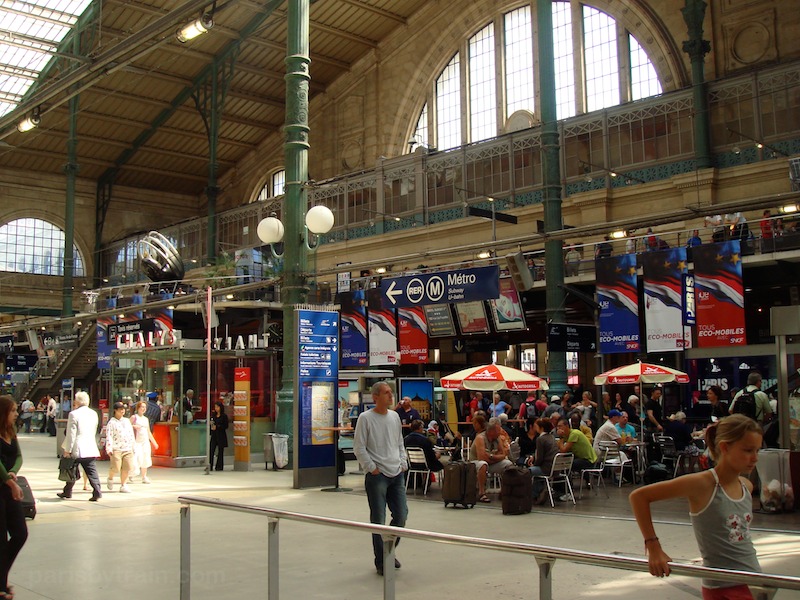
It took forever to go through the seemingly endless rail yards approaching Paris. I remember row after row of gray building jammed close together passing the sooty windows of the rail car. Although the rubble had been cleared away, 13 years after the end of WWII, the signs of war were still there.
We pulled into a huge station. We were allowed to briefly disembark but warned to stay in a clearly marked off area reserved for US military personnel. There was a Red Cross booth where the Donut Dollies handed out coffee and, yes, donuts. There was even a special restroom for us.

Once we were under way, I remember staring out the window. It took forever for us to leave the grayness of the city and, I don't ever think we were in a position to see the Eiffel Tower. The countryside was far more interesting once we got out of Paris. I don't remember seeing all the expected vineyards, just miles after miles of hedgerows delineating boundary lines between farms. We passed through small railroad stations, just as gray and disinteresting as the big city.
As in Paris, the one thing I noticed was the lack of beautiful, young women. All the females wore dark, long dressed with coats and drab head coverings. Looking back now, I'm somewhat certain that we stopped in Orleans to let some troops off. Our next stop was Tours and then Poitiers. The next leg was longer and we ate K-rations on the train for dinner. The only good thing was plenty of ice cold milk and, for those who drank it, hot coffee. It wasn't until late in the evening when we pulled into the huge station in Bordeaux.
Once again, we were herded by MPs, this time outside into the dark. All I remember seeing was the outlines of buildings with spiky roofs, shuttered windows and cobblestones in the big plaza in front of the station. We loaded onto two American-style school buses in the standard Olive Drab and headed off into the night. We crossed on, then another, large bridge I guessed spanned a big river. Then we drove into the dark night with widely scattered villages.
I think the thing that made Harold and I feel best was to be met by a First Lieutenant and a Sergeant First Class. They were clearly waiting for us and, after handing over the sealed envelopes with our personnel records, we saluted the lieutenant as he left and got into a three-quarters ton truck with the sergeant. He took us two a WWII barracks on the outer side of a military camp and led us up some outside stairs to the third floor.
“Welcome to your new home,” he told us. There were two vacant top bunks next to one another and a Specialist Five had us drop our duffel bags and follow him to a room where we signed for our foot and wall lockers as well as; sheets, olive drab, standard military; a blanket, olive drab, standard, military and a pillow, striped, feather, standard military. I don't remember much beyond that but to making my bed, putting my stuff in my wall locker, and falling into bed, instantly dropping off to sleep.
I don't think we got very much sleep. The Charge of Quarters came through, turned on the lights and yelled at us to “Hit the floor, then the door!”
I learned Harold and I were part of a small, separate platoon made up of the lieutenant, platoon leader, a warrant officer shop officer, the platoon sergeant and two specialist fives who only acted as squad leaders – we weren't organized like combat units. Every single one of them had Southern accents as this as anything I'd ever heard before in my life.
Everyone seemed quite happy to see us and went out of their way to welcome us and show us around. The mess hall was operated by the engineer construction battalion we were assigned to support and I quickly noticed our little group separated themselves from the others. We might have been in the land of “alimentaires magnifiques", but the mess hall food tasted exact like Army food everywhere else.
After breakfast, we joined all the other members of the platoon as they walked – not marched – from the battalion area to a gate allowing us to leave the confines of the base to cross a highway to another fenced-in area where a huge variety of large construction machines were parked. There was a very large building with bays where equipment was being worked on. Another bay lay at the very far end of the building and that was our destination. A big sign over the door said, 1st Platoon, 581st Engineer Company (Field Maintenance). Our Orderly Room was actually a small office in the back corner of the bay and that's where Harold and I reported in to the lieutenant.
It didn't take long until Harold was led off to have his work clothing issued. I had to stay behind to have a “small discussion” with the lieutenant and sergeant. They were not exactly pleased with the Record of Summary Courts Martial contained in my sealed personnel jacket. Both listened as I gave my side of the story. I only remember the lieutenant saying something about anything like that in his platoon and I would find myself in the stockade [confinement facility or military jail].
Not exactly an auspicious start to my stay in Southern France.
[And, sorry but photos of those days and place are very hard to come by.]

Sunday, July 24, 2011

An Army Ocean Cruise

[Just wanted to share some memories of a young man embarking upon his first true adventure.

Aboard a US Naval Troop Ship

In April 1958 with the pomp of the U.S. Army’s Engineer School’s graduation ceremony behind me. I, along with my buddy Harold, received orders to an engineer field maintenance platoon somewhere in Europe. The orders only indicated an army postal office, so we had no idea where. The orders also didn’t tell us how we were to get there, directing us to a replacement depot at Fort Dix, New Jersey.

We arrived at the Repo Depot and were shown to our rooms, a large squad bay in a barracks dating back to the Second World War. It had two floors, each with a large open bay. Double bunks lined both sides with wall lockers to stow our duffel bags. The décor was a dull olive drab with tile floors shined mirror bright. Sergeants had special rooms at both ends, so they were not required to mix with us plebes.

A Specialist Four informed us our assignment was somewhere in France, but not where.

France? Gee whiz. How exciting. That sounded great. I’d heard how beautiful and romantic France was. Great wine. Beautiful women. Awesome food. We could hardly wait to learn when and how we were going.

It took two days of Kitchen Police, Policing the Area [picking up tiny bits of paper and cigarette butts], along with polishing floors until we were told we weren’t going to McGuire Air Force Base but to the Brooklyn Navy Yard. 

Our orders directed us on an ocean voyage. How neat!

The olive drab bus probably served school kids a decade or so earlier. With duffel bags on our shoulders, we loaded up, filling all the seats with our big, heavy bags on our laps. We were all kinda surprised as there was only one bus.

There were no freeways or interstates between the fort and the city. I have no idea how long it took or even which bridge we crossed. I’d seen New York twice before, so the towering structures no longer impressed me. Harold came from Redding, a sort of small place in Northern California. That was his first time and he kept craning his neck to see everything.


The main gate had a huge banner welcoming us to Brooklyn Navy Yard and a sailor with an armband marked “SP” for Shore Patrol, came aboard the bus to ensure no Commie spies tried to get in. We drove through endless warehouses until we reached the docks. I’d been on fishing boats and the ferry between Long Beach and Catalina Island, so the troop ship impressed me as being huge.

Two smoke stacks rose above a dull gray superstructure. It had masts fore and aft. I shook my head. Why masts on a modern steamship? One of the stacks had huge letters announcing its name. I must admit that, after all these years, I can’t remember whether it was the General Patch or the General Rose. In any case, the hull had long red rust streaks cascading down the sides pierced with long lines of small circular holes. It didn’t exactly present an inviting façade. I later found a plaque indicating it had been launched some time in 1943 and guessed it’d been across the Atlantic more than one or two hundred times.

The buss turned down a very long pier and pulled up next to the boat. Uh, excuse me - I was quickly corrected that “she” was a ship. A sailor walked over and waited while we grabbed our gear and got off the bus. Once lined up, he led us to a long ramp thing with handrails. But, how much good would they do us as we needed one hand to balance the heavy duffel over our shoulders?

The tide was out, so the gangplank wasn’t steep. A sailor in clothing that certainly wasn’t military led us down some steep ladders or stairs or whatever they called those things. That wasn’t all that easy carrying duffel bags.

The senior man of our small, motley group was a specialist fifth class (equal to a sergeant but without the authority of a noncom). He was in charge simply due to his seniority. He had about as much gumption as a slug. He’d never led anything in his life. We were shown to an area in a huge bay. An endless array of poles with cots racked four high confronted us. The canvas cots were folded and it was up to us to decide who got which. Being innately lazy, I took the bottom bunk, as I had no desire to try to climb into the top.

I think the first thing that hit me below decks was the smell. The mass of human bodies had not yet entered, so the aromas came from stale seawater and diesel fuel. Add that to the confined space, and there was little doubt that no few passengers would spend time in the head, as they called the latrines, or hanging over the rail.

By the way - where were all the bodies that would normally fill the space?
And, if course, as we were about as important as slugs, nobody was going to tell us.

Once we’d secured our duffel bags to the stanchions, we were allow to go up on deck. I do remember there were forty-seven of us. As the bus was designed to hold forty-nine passengers and two seats were vacant, it wasn’t hard to figure out. Anyhow, that gave us freedom of the deck so we wandered around. On the side away from the dock, we could look out over a whole bunch of ships. There were a few sleek destroyers and some other vessels that appeared to be for shipping things (not too hard to guess as one had a bunch of CONEX containers being lowered into a hold. These Container Express things were made of corrugated metal and a very drab olive color. We were all very surprised to see tug boats with US ARMY painted on their smokestacks and crews wearing army fatigues. One skipper wore a floppy officer’s service hat with the distinctive warrant officer insignia. The other tugboat captain wore an equally floppy cap with bright yellow master sergeant stripes. Heck - none of the others had any idea the army had boats and crews. Harold and I did from our engineer mechanic’s school.

The ship had apparently been waiting for our pitiful number to board as the steam whistle high above us blew a couple of blasts that echoed back from across the oily water of the harbor. The tugboats replied and great swirls of foam appeared behind them as they pulled the ship away from the dock.

The tugs towed the ship out into the river and we began our voyage. We passed the Statue of Liberty and I thought how neat it was to see something given us by the people of the country I was going to spend the next two and a half years serving in.

Fair weather blessed us as we sailed down the east coast. At last, a crewman informed us we were on our way to Savannah, Georgia where we’d load troops from the 3rd Infantry Division on their way to Germany.

I had no idea which side of the boat was Port and which was Starboard. I did know what the bow and stern were. If the left side was Port, why should it be called that when we sailed south and the coastal ports were on our right side? Yes, I looked it up. Starboard comes from an old word for the side the boat was steered on and, as most were right-handed, they steered from the right side of the boat.

The waves didn’t rock the boat too much. But the side-to-side motion was a lot more unnerving than meeting them head on. We, of course, had plenty to do. The military cannot let soldiers idle, so there was more than a few things to keep us busy. First was cleaning and mopping our sleeping areas, along with the head. As there were just a few of us, we ate in a dining area on the deck-level looking out to sea. That meant we took turns doing Kitchen Police; washing pots and pans, peeling spuds, serving the others and all the things needed to keep the kitchen area clean to military standards. Thank goodness there wasn’t anyone else but us as we ate where the sailors did.

Basic training and the advanced school accustomed me to coffee. There was milk and soft drinks provided, but I first broke with my Mormon upbringing against drinking things with caffeine soon after arriving at Fort Ord for basic training. Army coffee had been powerful, but that on the ship was about as high octane as any I’d had. I also learned the secret of military coffee making when I watched a cook add eggshells to the coffee grounds in the massive coffee urns.

The food was far from haute cuisine. However, it was plentiful and nourishing. We ate on steel trays, passing down a line while the cooks and KPs slopped ladles of food into the various compartments.

The voyage didn’t last that long. As the sun rose the next morning, the ship
shoreward and we watched a small speedboat pull up next to the ship. We were told it was the harbor pilot and he quickly climbed the ladder thrown over the side. We then slowly sailed up a river that narrowed as we moved inland. The skyline of Savannah couldn’t compare to The Big Apple.


Civilian tugboats came alongside to nudge the ship against the docks. There were two other ships upriver from us and cranes busily lifted huge, corrugated steel CONEX containers on board. We watched transfixed as they began to lift tanks, armored personnel carriers, Jeeps and trucks from flat railcars into the holds of the ships. As each item was unloaded, their crews grabbed up their duffel bags and marched to one of the two gangplanks to our ship.

We also watched as the two masts of our ship turned into cranes to load endless boxes and crates into holds fore and aft. They contained food and the rest of the stuff to take care of the hundreds (perhaps thousands) of soldiers boarding.

It immediately became apparent the few of us who were not members of the 3rd Infantry Division were in for a long, difficult voyage. A three-striper sergeant (the next to lowest noncom rank) led his squad into our bay and immediately decided he wanted our area near the head (bathroom). We had to move our things to an area far from anything convenient. Tour moves continued with the arrival of other groups until we ended up in the least inviting space in the bay.

Loading proceeded quickly and we spent only one night tied to the dock. Division cooks quickly took over the various dining facilities and we instantly found ourselves on KP - again at the direction of a staff sergeant. Our bay held one infantry company so we were under the thumb of a crusty first sergeant who did not look kindly upon non-infantry types. His brown Ike Jacket was loaded with rows upon rows of ribbons showing he’d served in War Deuce, as well as Korea.


As the name refers, this jacket was designed by General Eisenhower during WWI and became standard when I enlisted. Yes, we wore the same brown uniforms with brown boots.

I was fortunate to be one of four of us topside when it came time to sail late the next day.

Our time topside and at the rails became drastically curtailed. As a kid, I had seen lots of movies and newsreels that showed how rough and difficult crossing the Atlantic could be. Fortunately, it was April and the weather treated us kindly. We encountered no storms. (At least from Mother Nature.)

I have learned great respect for those who serve in the combat branches of the military. However, as a brand new, green recruit with two scrolls showing I was a fully qualified repairman of very complicated and large building machine, that was far from my thoughts. The guys surrounding me were a bunch of “ground-pounders” with no skills besides marching and digging holes in the ground. It was made worse by the total disdain exhibited by the grunts against us few clerks and grease monkeys. 

However, the voyage was far from boring - at least for me. I learned military customs and law in boyhood. It came when I was a Boy Scout. I understood the Uniformed Code of Military Justice and that it was a big NO-NO to talk back to a soldier of senior rank. However, I also had (have?) a bit of a temper. It flairs quickly and subsides just as fast.

I had a day off from what seemed to be constant KP or latrine duty. I made the mistake of not leaping out of bed when Revile sounded. My endearing Buck Sergeant came along and kicked me through the bottom of my cot, screaming at me to hit the deck.

I boiled. I slowly rose and looked him straight in the eye and said, “You are an ignorant, illegitimate offspring of a female canine.” I then turned to gather my clothing.

“What did you call me?” he screamed. When I didn’t repeat it, he turned to one of his grunts and asked what I’d said. “He called you a stupid bastard son of a bitch, Sarge,” he said.

My fellow transients (as we were called) covered their smiles, but some of the sergeant’s fellow grunts who didn’t hold him in very high esteem, snickered loudly, some even laughing.

The sergeant turned beet red, clenched his fist and ordered me to follow him, not letting me put on anything beyond my skivvies but my combat boots. He marched me to his platoon sergeant, told him what he’d been told I’d said and demanded I be punished for it.

In any other situation, the most it would have earned me was nonjudicial punishment levied by the company commander. It would probably have resulted in confinement to quarters and maybe a fine. However, as we were aboard ship and I wasn’t assigned to any element of the division, the legal types determined I had to appear before a Summary Courts Martial.

The sergeant stood to one side as a major read the charges and asked if I was guilty or not. One of the division’s lieutenants had been appointed as my defense and advised me to keep my mouth shut and let him talk. He pled guilty with mitigating circumstances, indicating the sergeant had kicked me out of sleep. I was asked to repeat the words and told him I couldn’t remember them. He asked the sergeant and he couldn’t repeat them either. Someone had made a statement and that was read into the record.

The end result was losing my pretty yellow private first class stripe, having two-thirds of my pay forfeited for three months and an additional three months restriction to base. All for telling off an ignorant, acting three-stripe sergeant.

From that time forward, the sergeant’s superior kept a close eye on me. I got every crappy job and detail possible. I learned the fine art of chipping thick layers of paint from metal, sanding it clean, then repainting it with the same ugly dull color. I discovered why old movies showed sailors on their knees rubbing the decks with stones - it’s to make the deck less slippery when it gets wet.

The good thing about working the decks was being outside the ship’s holds and the growing aroma of human bodies crowded together. 

Entering the English Channel was a milestone for all - especially me as it meant my torture was nearing an end. We could barely see the famous White Cliffs of Dover off to the west.

Crossing the Atlantic hadn’t been all that rough. But, the Channel was choppy and it rained from the moment we entered until we sailed into the North Sea to turn towards Bremerhaven, Germany. I’d never seen a major harbor before and couldn’t comprehend the magnitude of that major German seaport. New York’s harbor was tiny in comparison. Ships beyond count sailed in and out. Endless piers with cranes busily loaded and unloaded ships. I quickly appreciated the skill it took to guide an ocean-going vessel through the traffic to a relatively small pier.

As the division troops had to wait for their equipment to be offloaded, we transients were first off the ship. They bussed us to another replacement depot where we were blessed by a night of sleeping on a double-tiered bunk in an environment that didn’t constantly move. The mess hall food was military-standard, but didn’t smell of diesel fuel and seawater.

We lined up early the next morning after breakfast and Harold and I first learned our destination - first stop, Saintes, then to some place further south called Landes de Bussac. There was even a map on the wall to show it was near a big city called Bordeaux.

We were led to a platform next to a train with US ARMY TRANSPORTATION CORPS boldly splattered on the cars!
So, the army not only had a navy, but trains too?

Welcome to Europe! Welcome to Germany! We sat, glued to the windows, watching the new world pass by. With only a bit over a decade since the end of the war, the rebuilding amazed us. Houses and buildings were laden with flower boxes bursting with colorful blooms. Clean streets dominated the vista and we saw no trash lying around. It was everything I’d expected.

Then, the train stopped and our car was disconnected and switched to a French locomotive. We had to wait while French policemen came through the cars followed by US Military Police. Why on earth did they have to inspect us? Who did they expect to be on a US military train? (I also noticed they didn’t seem to know the regular use of bathing facilities.)

The change in the countryside shocked me. The houses and buildings were a gloomy, sooty gray and I saw signs of destruction left over from the war. The French wore drab clothes. There wasn’t a single Bridget Bardot or her equal anywhere in sight. In fact, I quickly learned that most of the women we encountered had not yet become accustomed to the regular use of a razor. I also rapidly became aware of why perfume and cologne had been invented.

Welcome to the land of boors, snobs and drab colors. What an end to my first ocean voyage.

The End - and I hope you enjoyed it!!!